Mottingham Skip Hire: Recycling and Sustainability
 At Mottingham Skip Hire we take an active role in promoting eco-friendly waste disposal across Mottingham and the surrounding boroughs. Our approach to sustainable rubbish collection combines practical skip hire services with an ambitious recycling strategy. We work closely with local authority frameworks — notably the waste separation policies of the Royal Borough of Greenwich and the London Borough of Bromley — to ensure that paper, card, glass, and food waste are diverted away from landfill and into appropriate reuse and treatment streams.
We run a tailored programme for both domestic and construction customers of Mottingham skips that emphasises source separation. Builders and householders are encouraged to separate inert materials (brick, concrete, soil), metals, wood, and mixed recyclables at point of collection. Our team provides clear signage on every hire, plus sorting guidance to maximise recovery. This local, hands-on approach helps align our operations with borough-level initiatives such as separate garden-waste and food-waste collections and communal recycling schemes.
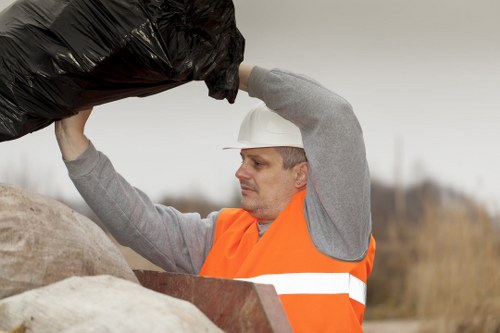 Our corporate target is bold: we aim for a minimum of 85% of skip contents to be diverted from landfill and recycled or reused by 2028. That recycling percentage target is tracked monthly with independent audits and materials recovery tracking. Where materials cannot be recycled, we prioritise recovery (for example crushing concrete into aggregate) or energy-from-waste options that carry a lower environmental footprint than landfill. Our Mottingham waste disposal services are designed to deliver measurable reductions in local landfill tonnage.
 Partnerships are central to our sustainable rubbish programme. We work with a network of local transfer stations and materials recovery facilities (MRFs) in the boroughs to ensure efficient sorting and processing. By routing skips through nearby transfer stations we reduce haulage distances and processing times. These transfer stations accept separated streams—glass, paper, metals, plastics—and send them to specialised recyclers, while inert aggregates are processed for reuse in construction.
We also have established relationships with community reuse organisations and charities across Mottingham and neighbouring areas. Donations of reusable furniture, doors and windows, working appliances, and surplus building materials are regularly diverted to local charities and social enterprises. These partnerships not only reduce waste but support community projects and reuse markets — preventing functional items from needing recycling or disposal at all.
To support circular economy practices we operate a dedicated bulky waste to reuse channel: items that are still in good condition are assessed, cleaned, and collected for redistribution. This complements formal recycling routes and aligns Mottingham skip hire services with the boroughs' emphasis on reuse and repair as the first step in waste hierarchy.
 Our transport strategy is built around low-carbon delivery. We have invested in a modern fleet of low-emission and electric vans for local collections and deliveries, and hybrid vehicles for longer hauls. Vehicle routes are optimised with telematics to reduce mileage and idling time, which lowers carbon emissions and noise in residential areas during busy collections.
We also run regular driver training on eco-driving techniques and load optimisation so fewer journeys are needed. For larger loads we partner with reputable, licensed haulage operators who share our sustainability commitments, ensuring that even long-distance transfers use the most efficient and least carbon-intensive vehicles possible.
Types of Recycling and Local Activity
- Construction and demolition waste: concrete, brick, and hardcore crushed and re-used as secondary aggregate.
- Metals and timber: high recovery rates with metal separated for smelting and wood sent for recycling or biomass where appropriate.
- Household recyclables: glass, plastics, paper and card sorted and processed through local MRFs in line with borough schemes.
- Green waste: garden and food waste directed to composting and anaerobic digestion facilities.
Community and Regulatory Alignment
Our operations follow the principles set out by local authorities, with ongoing liaison to ensure compliance and to support borough campaigns on waste separation, contamination reduction, and increased recycling participation. By combining Hampshire-style logistics (efficient transfer routing) with local partnerships and community-focused reuse, our Mottingham skip hire model aims to set a local standard for sustainable rubbish management.
Commitment summary: an 85% recycling target by 2028, active collaboration with local transfer stations and MRFs, strong charity partnerships for reuse, and a low-carbon vehicle fleet — all designed to make eco-friendly waste disposal the default choice across Mottingham and nearby neighbourhoods.